
The Medina Beyond the Souk
There is a saying that the best way to understand a place is to get lost in it.
The Medina of Tunis certainly invites that kind of wandering. Narrow alleyways twist in every direction. Blue doors catch your eye. Cats nap in patches of shade while the scent of spices, jasmine, and fresh bread drifts through the warm air. It would be easy to spend hours browsing souvenir shops and leave believing you had experienced the Medina.
Our guide smiled as he led us away from the crowds.

“The tourists go that way,” he said, pointing toward the busy commercial streets. “We are going this way.”
That simple turn changed everything.
Suddenly the souvenir shops disappeared. We found ourselves in neighborhoods where families still live behind centuries old doors, where neighbors know one another, and where traditions continue quietly, often unnoticed by visitors.
It was exactly what I had hoped to find.
Since completing my journey of cooking a meal from every country in the world, I have become increasingly interested in something beyond recipes. I want to understand the traditions that surround food, the crafts that support it, and the stories that are slowly disappearing. The Medina felt like stepping into one of those stories.
Our first stop was the neighborhood market.

Unlike the colorful stalls aimed at tourists, this was where local families came to buy their daily groceries. Vendors called out prices while shoppers carefully selected peppers, tomatoes, herbs, lemons, olives, and fish for the day’s meals. Elderly women carried baskets filled with vegetables while children darted through the narrow aisles.

I loved watching everyday life unfold.
Nearby was an entire street devoted to dates. Their sweet aroma filled the air as merchants proudly displayed varieties harvested in southern Tunisia.

Our guide explained that many Tunisians begin their mornings with dates and butter or dried figs drizzled with olive oil. Sometimes the simplest traditions tell you the most about a culture.
Not far away we wandered into the medicinal plant market.
Bundles of herbs hung from every stall, each with a purpose known by the vendors who had learned their uses from generations before them. Hibiscus for blood pressure. Chamomile for sleep. Olive leaves brewed into tea. Dried pomegranate peel for an upset stomach. Eucalyptus to ease breathing.

My favorite moment came when our guide placed a few drops of orange blossom water into our hands.
“We never leave home without it,” he said.
The delicate fragrance instantly cooled my face despite the forty five degree heat (113F). Around us, women continued purchasing flowers that would later become essential oils, perfumes, and massage oils using traditional copper stills. One tiny bottle requires kilograms of fresh petals and hours of patient distillation.
The work continues today, just as it has for generations.
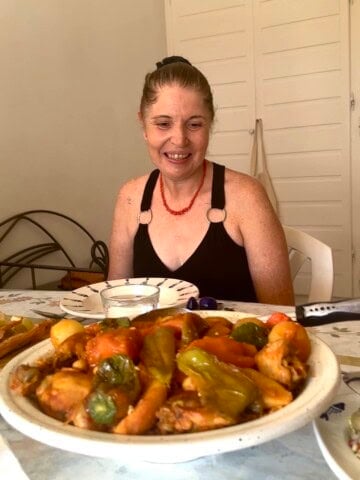
As someone who had just spent the previous day cooking with a Tunisian family, I began seeing connections everywhere. Jiji had proudly shared her homemade harissa and the olive oil pressed from her family’s own grove. Now I understood that those ingredients were part of a much larger story that stretched from the countryside into the Medina itself.
Everywhere we walked, history quietly revealed itself.
Roman columns taken from ancient Carthage now supported homes built more than fourteen centuries ago.

Ottoman palaces had become guest houses, wedding venues, and cultural centers. Beautiful carved doors displayed symbols that spoke of Berber, Andalusian, Turkish, and Arab influences, each layer adding another chapter to Tunisia’s remarkable history.

Yet what moved me most was not the architecture.
It was the people still keeping these traditions alive.
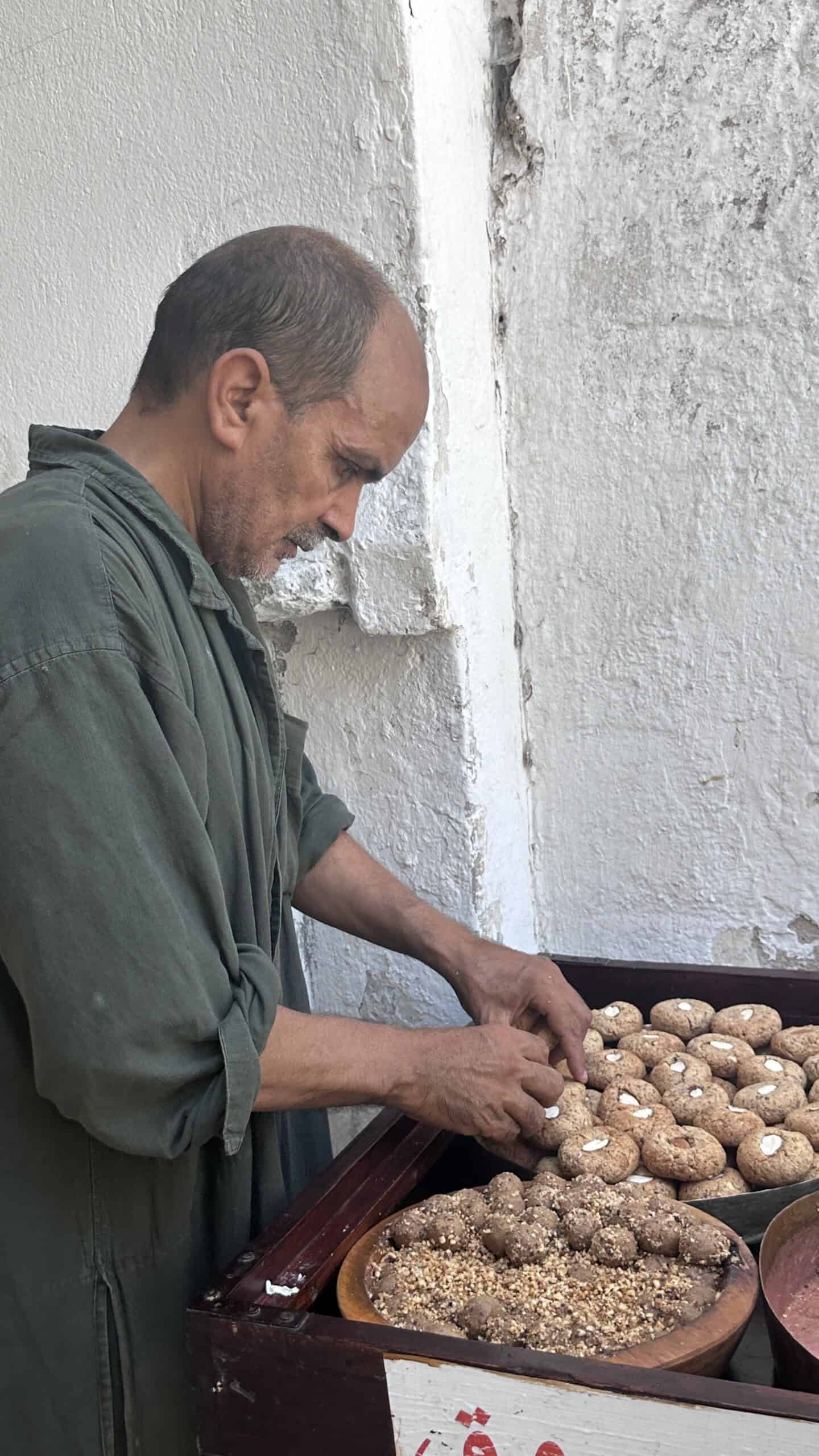
Berber women continue weaving kilims by hand using techniques their grandmothers knew. Families still distill jasmine and orange blossom into fragrant oils. Local cafés continue welcoming neighbors who have gathered there for generations.
The Medina is not preserved behind museum walls. It is still lived every single day.

At one point I told our guide about my dream of returning to Tunisia in October to help harvest olives with a local family.
He smiled.
“You will be welcome.”
Perhaps that is what I will remember most about Tunisia.
Not only its beautiful blue doors or ancient palaces, but the warmth of the people who so generously invited me into their traditions. Whether sharing homemade harissa, offering the scent of orange blossoms, or explaining the healing power of herbs, they seemed genuinely eager for visitors to understand their culture rather than simply observe it.

As we finally emerged back into the busy commercial streets, I realized the greatest treasures of the Medina were never the things for sale.
They were the stories, the traditions, and the people quietly keeping them alive.
Until next time,
Bislema ("wishing you safety" in Arabic)
Darlene
Leave a Reply