
How Did Uganda Get Its Name?
Uganda takes its name from the ancient Kingdom of Buganda, one of the most powerful and influential kingdoms in East Africa. When British explorers and colonial administrators arrived in the region during the nineteenth century, they used the name “Uganda,” an English adaptation of “Buganda,” to describe the wider area.
Uganda gained independence from Britain on October 9, 1962, and has since become known as the “Pearl of Africa,” a nickname popularized by Winston Churchill for its remarkable natural beauty, abundant wildlife, and fertile landscapes.
Where is Uganda Located?
Uganda is a landlocked country in East Africa. It shares borders with South Sudan to the north, Kenya to the east, Tanzania and Rwanda to the south, and the Democratic Republic of the Congo to the west.
Although it has no coastline, Uganda is home to a significant portion of Lake Victoria, Africa’s largest lake and the source of the Nile River. The country’s diverse landscape includes rolling hills, lush rainforests, vast savannas, volcanic mountains, and numerous lakes and rivers.
Its capital city is Kampala, situated near the shores Lake Victoria, a vibrant metropolis built upon seven hills that serves as the country’s political, cultural, and commercial center.
Sitting on the equator, you can stand with one foot in Northern Hemisphere and one foot in the Southern Hemisphere at several marked points across the country.
A Brief History of Uganda
Human settlement in Uganda dates back thousands of years. Over the centuries, several powerful kingdoms emerged, including Buganda, Bunyoro, Toro, and Ankole. These kingdoms developed sophisticated political systems, thriving agriculture, and extensive trade networks long before European contact.
In the late nineteenth century, Uganda became a British protectorate. Railways, schools, and new administrative systems were introduced during colonial rule, although many traditional ways of life were disrupted.
Uganda achieved independence in 1962. The decades that followed included periods of political instability, most notably during the dictatorship of Idi Amin in the 1970s. Since the late twentieth century, Uganda has experienced greater stability and economic growth while continuing to celebrate its rich cultural traditions.
Today Uganda is renowned for its extraordinary biodiversity, including nearly half of the world’s remaining mountain gorillas, over one thousand bird species, and some of Africa’s most spectacular national parks.
Ugandan Culture
Uganda is home to more than fifty ethnic groups, each with its own language, customs, music, dances, and culinary traditions. While English and Swahili are official languages, Luganda is one of the most widely spoken.
Family and community are central to Ugandan life. Hospitality is deeply valued, and visitors are often welcomed with generous meals and genuine warmth. Music and dance play an important role in celebrations, weddings, and religious festivals, with long drums called ngalabi serving as one of the country’s most recognizable cultural symbols.
Agriculture remains the backbone of daily life for many Ugandans. Coffee is the nation’s most important export, recently surpassing Ethiopia, is one of Africa’s leading coffee producers. Cotton, tea, bananas, peanuts, and maize are also widely grown throughout the country.
Uganda is home to the world's youngest population where roughly seventy seven percent of the citizens are under the age of thirty. This youthful energy shapes the country's vibrant social life, tech scene and modern culture.
Football, known locally as soccer, is by far the most popular sport, bringing communities together to cheer for their favorite clubs and the national team, the Uganda Cranes.
The national bird, the elegant Grey Crowned Crane, symbolizes grace and resilience and proudly appears on Uganda’s national flag and coat of arms. Uganda is also a bird watchers paradise with over 1000 bird species who call Uganda home, which makes up about ten percent of all bird species on earth.
Uganda is also home to roughly half of the world's remaining wild mountain gorilla population, mostly found in Bwindi Impenetrable National Park and is a big draw for tourism in the country.
Ugandan Cuisine
Ugandan cuisine reflects the country’s fertile land and agricultural abundance. Fresh ingredients are the foundation of everyday cooking, with bananas, cassava, sweet potatoes, beans, maize, millet, groundnuts, and leafy greens appearing regularly on family tables.
It avoids heavy and overwhelming spices, favoring the natural earthy flavors of local ingredients.
Like most countries traditional staples vary by region but here heavily feature carbohydrate rich starches like maize meal called posho, kalo which is a thick doughy staple made by mixing millet and cassava flour with water, and plantains called matoke, rice is also popular.
Groundnut sauce is the culinary glue of Uganda, acting as the primary protein companion for the many starches. Unlike western peanut butter, these groundnuts are red skinned, sweeter and earthier. They are ground into a fine flour and used as the base of sauces.
Matoke is a variety of green banana, is considered to be Uganda's national dish, The bananas are steamed until tender and often served with rich stews made from beef, chicken, vegetables or groundnut (peanut) sauce.
A beloved cultural delicacy is luwombo, which consists of meat, fish or groundnut sauce steamed perfectly in banana leaves.
On the streets, the rolex, a rolled chapati filled with eggs and vegetables is a popular, ubiquitous favorite. It got its name rolex from a misunderstanding of a person saying rolled eggs and it has stuck.
Nsenene is a highly sought after seasonal delicacy of grasshoppers harvested during the rainy months of May and November. They are plucked, cleaned and pan fried with onions and salt until crispy and golden.
So let's enjoy a Ugandan Meal
Starter
Rolex (Rolled Eggs)

Main Course
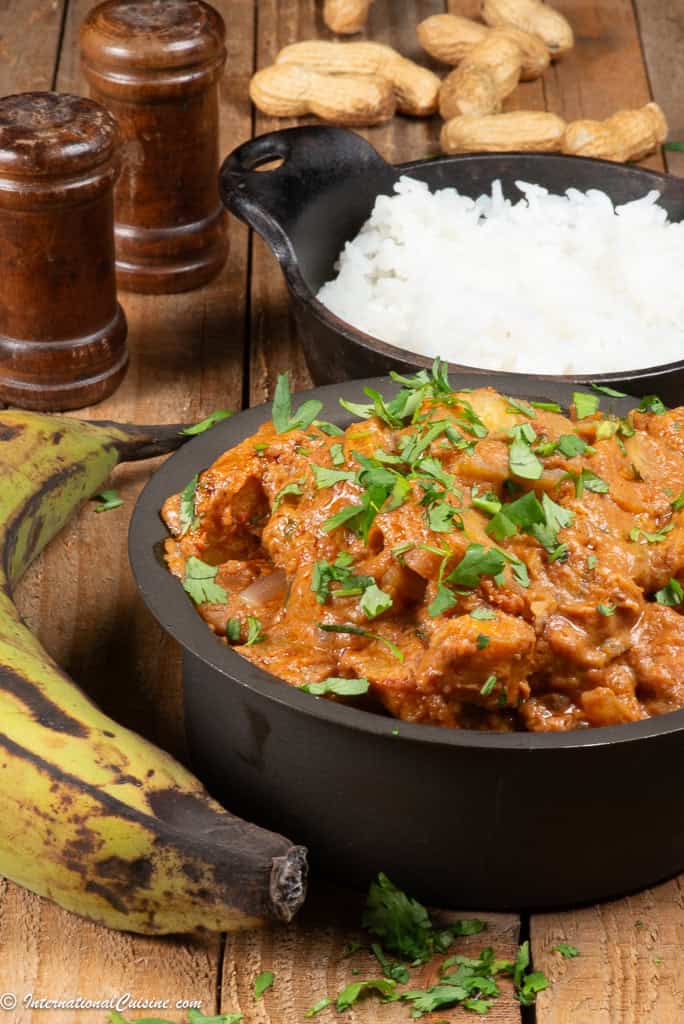
Matoke (Banana Stew in Peanut Sauce)
Dessert
Queen Cakes (Ugandan Muffin)

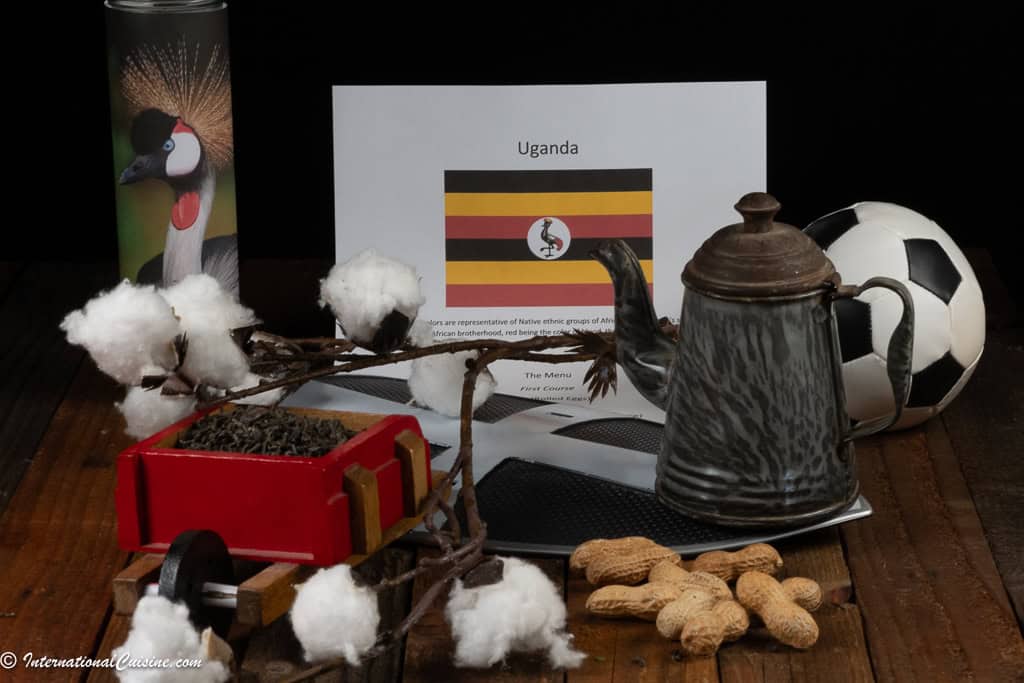
We decorated our table with cotton, coffee beans, peanuts, a soccer ball, and a photograph of the Grey Crowned Crane, Uganda's national bird and a traditional coffee pot. Together these simple touches reflected the country's rich agricultural heritage, love of football, world-renowned coffee, and remarkable natural beauty.
We began with Uganda's iconic street food the rolex, a warm chapati wrapped around freshly cooked eggs and vegetables. Simple, inexpensive and satisfying. It has become a beloved breakfast and snack throughout the country and we loved it as our starter.
For the main course we served matoke banana stew with peanut sauce. The creamy green bananas paired beautifully with the rich, nutty sauce, creating a comforting dish that perfectly showcases Uganda's most important staple crop.
Dessert was queen cakes with orange zest, light spongy muffins that paired exquisitely with a cup of Ugandan coffee. Their delicate citrus flavor provided a lovely finish to the meal while celebrating one of Uganda's favorite homemade treats.
As we gathered around the table, we were reminded that Uganda's story is one of resilience, hospitality, and abundance. Every dish offered a taste of nation where fertile landscapes, vibrant traditions, and welcoming people come together to create an unforgettable culinary experience.
Ugandan culture is rich with proverbs that reflect the values of community, patience, and resilience. Here are a few that beautifully capture the spirit of the country:
“A child does not grow up only in a single home.”
This proverb reminds us that raising a child is a shared responsibility within the community.
“Little by little fills the measure.”
A reflection on patience and persistence, emphasizing that small efforts over time lead to great results.
“The one who asks questions does not lose his way.”
A reminder of the importance of curiosity, learning, and seeking guidance.
After dinner and for a deeper glimpse into Uganda’s people and landscapes, we watched the documentary “Virunga” which offers a powerful look at the country’s neighboring region and the conservation efforts to protect mountain gorillas, while also highlighting the broader challenges and beauty of Central Africa.
Another compelling film, “Queen of Katwe,” tells the inspiring true story of a young Ugandan girl from Kampala who rises to international fame through chess, showcasing resilience, hope, and the strength of community.
Together, these words and stories offer a meaningful window into Uganda’s heart where wisdom is passed down through generations and everyday life is filled with perseverance, dignity, and hope.
Until next time,
Warmest regards,
Darlene
Leave a Reply